
Frigates that are Frigates
Fleet Logic Issue 29 March 20th, 2026

“And we can get back to the basics
Like we were meant to do” - Kip Moore, Mr. Simple, off Damn Love, 2023
Last week, I presented my proposal for a new class of guided missile destroyers based off of the work that was done converting the FREMM frigate into the cancelled Constellation-class frigate. This class is intentionally smaller and less expensive than the Arleigh Burke-class, which will allow the U.S. Navy to afford to build more of these important escorts.
This week, we will be looking at the area of small surface combatants, specifically, frigates.
How We Got Here
Since the end of production on the Oliver Hazard Perry-class guided missile frigates, the U.S. Navy has been searching for a successor in this small surface combatant role.
The first ships built were the Littoral Combat Ships (LCS). The Freedom- and Independence-class ships were not introduced as frigates, but instead as a small surface combatant type optimized for operations in the littorals, modularity, and speed. The first ship was delivered in 2008. Unfortunately, the envisioned crewing structure did not deliver the anticipated results. Nor did the mission packages deliver on time, or with the capability originally foreseen. The anti-submarine warfare package was cancelled, and the mine hunting package was not deployed until 2025. (See USNI News: Navy Deploys First Operational LCS Mine Countermeasures Packages) USNI News
In need of a true frigate design, the navy turned next to the Constellation-class. The intent of this program was to give the fleet a capable, multi-mission frigate derived from the Franco-Italian FREMM design. In concept, this was a logical step: leverage an existing, proven hull and adapt it to U.S. Navy requirements. In execution, however, the program has followed a pattern that has become all too common. Requirements expanded, systems were added, and the design diverged further from its parent. Cost and complexity increased accordingly. What began as a relatively low-risk adaptation became a new ship in all but name, with the associated delays and risks that accompany such an approach. (See USNI News: Constellation-class: the US Navy’s struggle to forge a new generation of frigates) USNI News
As of now, only the first two Constellation-class ships, Constellation and Congress, will be built. The current administration decided that, rather than continuing to pursue this delayed and increasingly complex frigate, that the Navy should move toward a different design. In the words of the Secretary of the Navy “the Constellation-class frigate was canceled because, candidly, it didn’t make sense anymore to build it. It was 80 percent of the cost of a destroyer and 60 percent of the capability. You might as well build destroyers.” He had a point. Frigates and destroyers should be distinct things. As noted last week, we can, and I believe should, build the Constellation design into a destroyer.
That still does not give us a frigate.
To replace the Constellation program, the Department of the Navy chose a simpler ship based on the National Security Cutter. This approach prioritizes speed of acquisition and reduced design risk. It accepts a lower level of complexity in order to get hulls in the water more quickly. This is a meaningful shift, but it also raises a fundamental question: whether a cutter-derived platform, designed with different assumptions, can fully meet the demands of a modern frigate operating in contested environments.
Since the original announcement, we’ve learned that the initial FF(X) will carry a 57mm main gun, the same as the one on the NSC, a 30mm auxiliary cannon, and a Mk 49 launcher for Rolling Airframe Missiles. A large aft payload space is provided, which gives the ability to carry 16 Naval Strike Missiles (NSM) or other containerized systems, like the Mk 70 launcher, for example. Overall, the ship’s general characteristics are quite similar to its National Security Cutter parent design. (See Naval News: New U.S Navy Frigate: FF(X) Program Specs Revealed) Naval News
Based on what we know, I do not believe FF(X) is the answer.
What a Frigate Is Actually For
To understand why, it’s worth looking at what a frigate should be. As a small surface combatant, a frigate should have one core mission—anti-submarine warfare (ASW), anti-air warfare (AAW), or anti-surface warfare (ASuW)— and be built to achieve that purpose.
A secondary capability is fine, but it is a supplement, not the point. For example, an ASW frigate can carry a battery of anti-ship missiles, as all surface combatants should be able to engage other surface targets, but then its AAW systems must be tailored for local defense rather than area defense, as anything else risks mission creep or massive size increases. To be truly effective, the ship must have that one clear job, one clear purpose that it does well.
The reason I do not see the FF(X) as being the ultimate answer to the fleet’s frigate needs is that it does not have that one clear, focused mission. The fixed equipment is suitable for a patrol vessel—like a cutter. The ability to carry the containerized systems gives the allure of flexibility, but that is a film that we’ve already seen with the LCS mission packages. Giving it the 16 NSMs does place it into a primary ASuW role, which would also be the likely role if it were equipped with the Mk 70 launchers.
There is nothing wrong with this role, but we do not actually need to build this design for it. We already have 28 ships available that can fill the role. The ships I am speaking of are the members of the Freedom- and Independence- classes, which I recommend reclassifying with a hull symbol of FP, for patrol frigate. This change clearly separates the ships from their former mission as littoral combatants and recasts them into their new role. (See: US Navy: Fact File Littoral Combat Ship Class - LCS) Fact File
As FP, these ships should be outfitted with the surface warfare mission modules, and augment those weapons with 8 NSMs and a pair of MK 70 launchers. So equipped, these ships would have firepower equal to the proposed FF(X) along with greater speed, and they could be ready to go for these roles quickly. I outlined this approach in a previous article. The minesweeping role some of these ships are currently tasked with would need to be filled, of course, which I plan on discussing in a future article.
So configured, these ships could handle many low intensity situations. For example, anti-piracy patrols would be a natural fit. They could provide admirable service in counter-narcotics patrols as well. Using them for these jobs frees up larger, more capable vessels like DDGs for higher intensity tasking.
This does not fully answer the frigate question. Ships beyond the LCSs will be needed. Specifically, the Navy needs ASW frigates capable of finding, tracking, and, if necessary, destroying submarines in open ocean and convoy environments. This requires a combination of hull-mounted sonar, towed array systems, embarked helicopters, and sufficient endurance to operate independently or in dispersed formations. That should be the primary role of new frigates that are added to the fleet.
Air defense should be their secondary function, and each ship should be equipped to defend itself and provide limited local area defense for nearby ships. A small number of anti-ship missiles should be carried, but that role is clearly tertiary.
What I feel we really need is a modern equivalent of the FFG-7 class.
The Modern FFG-7 Concept
To understand what a modern frigate should be, it is worth briefly looking at the last time the U.S. Navy got this right.
The Oliver Hazard Perry-class (FFG-7), was designed as a purpose-built escort, optimized primarily for anti-submarine warfare and convoy protection. The design was disciplined. The ships displaced approximately 4,100 tons. They carried ASW torpedoes and, most importantly, two embarked helicopters. These significantly extended their anti-submarine reach and made them highly effective platforms for their size. A single Mk 13 launcher provided both the secondary AAW capability with SM-1 surface-to-air missiles and a tertiary ASuW capability via Harpoon missiles, A 76mm gun and a CIWS rounded out their weapons load.
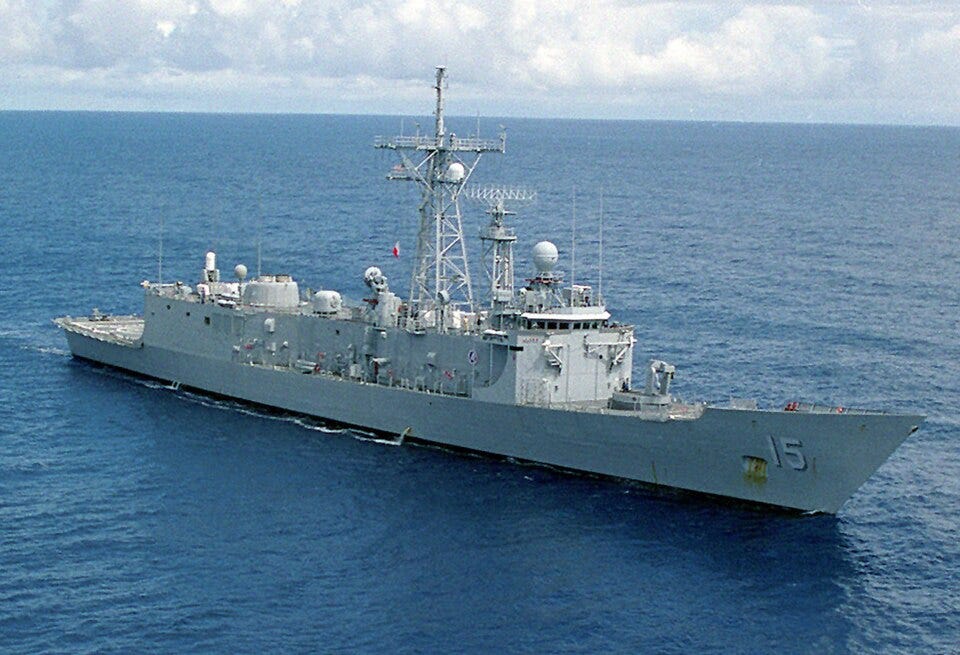
The Oliver Hazard Perry-class was not a destroyer. Its air defense capability was limited compared to larger ships, but it was effective at its mission, affordable to procure, and numerous enough to matter. It was a focused ship, built with clear priorities and protected from uncontrolled growth in requirements.
That model remains valid.
A modern frigate should be defined by the same discipline in design. The objective is not to build the most capable ship possible within a notional category, but to build a ship that performs its mission effectively, can be produced in numbers, and does not collapse under its own cost.
Limiting displacement to a maximum of 5,500 tons provides sufficient space for sensors, weapons, and aviation facilities without driving costs into destroyer territory. A 16-cell Mk 41 Vertical Launch System provides the ship with stand-off ASW capability via 8 VL-ASROC ASW missiles, which is an improvement over the FFG-7, which lacked ASROCs. Loading the remaining 8 cells with quad-packed ESSM gives a total of 32 total missiles for air defense. This total load of 40 missiles is comparable to the load carried by the Oliver Hazard Perry-class ships.
Eight anti-ship missiles, preferably NSMs, offer credible offensive ASuW punch. A 57mm gun provides additional ASuW fire as well as defensive fire against UAVs and small craft. For close-in defense pairing a SeaRAM CIWS with a Phalanx CIWS provides an upgrade in this critical area.
The ship must include both hull-mounted sonar and a towed array, along with a helicopter for extended ASW reach. Speed in the high 20-knot range, with a preference for approaching 30 knots, is sufficient for escort and screening operations. Naturally, I would prefer the higher speed, but it is worth noting that most currently in production guided missile frigates have top speeds in the high 20s, so that speed would fit within international norms.
Most importantly, the ship must aim to be under $1 billion per hull—with $800 to $850 million as a target.
The 16-cell Mk 41 Vertical Launch System may seem small at first glance, but the choice is intentional. Expanding beyond 16 cells introduces the temptation and pressure to add additional mission sets, like land-attack missiles such as Tomahawk. That, in turn, drives growth in command systems, targeting requirements, and cost. By deliberately limiting the VLS count, the design resists this expansion and remains aligned with its primary mission.
This is not a lesser ship. It is a focused ship.
Proof the Model Still Works
The idea of a modernized FFG-7 equivalent is not theoretical. It’s been demonstrated in practice.
The Turkish Navy acquired and modernized several ex-U.S. Navy Oliver Hazard Perry–class frigates. These modernized versions provide a clear example of what a focused, mid-sized combatant can achieve. The upgrades include 8-cell Mk 41 Vertical Launch Systems with 32 quad-packed ESSM, modern radar systems such as SMART-S, and updated combat management systems. They retain their original Mk 13 missile launcher and their anti-submarine warfare capabilities, including torpedoes and embarked helicopters. (See The War Zone: Project GENESIS: How Turkey Resurrected Its Secondhand Oliver Hazard Perry Class Frigates) The War Zone
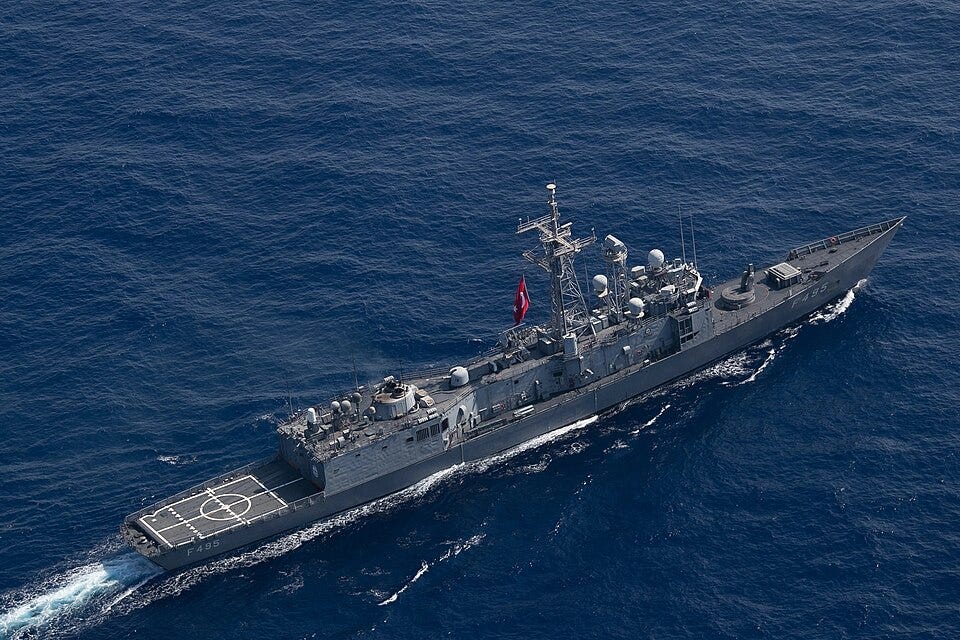
I am not using this example to argue that we should refit our handful of decommissioned FFG-7 class ships. Nor am I saying we should build new examples of that class. The point is the underlying idea that a frigate of this size can be properly equipped to perform in a modern context.
We need to look to acquire such frigates.
A Two-Step Approach: Step One
The Navy’s immediate challenge is not theoretical. It requires additional hulls in the water as soon as possible—hence the focus on speed of construction over actual capability in the FF(X) program. Speed cannot be the only consideration, though, capability must also have a real seat at the table.
Because of these competing factors, the most practical approach is a two-step one. Step one is to procure an initial batch of 10 ships based on an existing design that is proven and in service. This already sounds hauntingly familiar, I know, and the ghost of the Constellation-class hangs heavy over the concept—which it should.
It should hang over this approach as a cautionary tale against making all but the most necessary of changes to the design. Past difficulties must be learned from, and the discipline to apply those lessons must be maintained. Americanization for communications, weapons integration, and survivability requirements must be kept minimal to prevent the costs from ballooning.
Further, in order to take advantage of warm production lines, and thereby get the ships built faster, serious consideration must be given to having the ships built in foreign yards. This is a controversial approach, and not without difficulty. For starters, U.S. warships are prohibited from being built in foreign yards. This can be overcome by the issuance of a presidential waiver if the President determines that it is in the national security interest of the United States. This waiver does require the President to notify Congress, and cannot contract until 30 days after this notification. (See USCODE: 10 USC 8679) US CODE
Aside from the legal (and political) issues, security must be considered. Foreign espionage is a risk, and this concern must be taken into account. That said, espionage is a concern in domestic yards as well. Proper security measures would need to be agreed upon, by the U.S. government and the government of the building nation, and guarantees made, before construction could begin.
Existing Designs That Meet the Requirement
There are several foreign designs that could be adapted for the initial 10 frigate buy. Two such designs are presented here in brief. Both are highly capable platforms built in allied nations.
A. Mogami-class (Japan)
The Japanese Mogami-class frigate is a clear example of a modern, cost-controlled design aligned with an ASW-first concept. Displacing roughly 5,500 tons with a crew of about 90, it emphasizes automation, reduced manning, and efficient construction while maintaining a credible combat capability. It includes a 16-cell Mk 41 Vertical Launch System, anti-ship missiles, 5” gun, and a full ASW suite with towed array sonar and an embarked helicopter.
Originally priced under $500 million per ship, the class remains well below the cost of larger Western surface combatants even after accounting for inflation. Americanization will drive the price higher. Still, the Mogami-class is a disciplined, ASW-focused frigate. (See Naval News: Japan’s MHI launches final Mogami-class FFM for JMSDF) Naval News
B. FDI (France)
The French Frégate de Défense et d’Intervention (FDI) represents a more capability-heavy but still bounded frigate design. At approximately 4,500 tons, it combines advanced sensors, including the Sea Fire AESA radar, with a balanced multi-mission capability suitable for high-threat environments.
The design incorporates modern survivability features and a robust combat system, but at a higher cost point. Current estimates place the FDI in the upper range for frigates, approaching the threshold where cost begins to constrain procurement in meaningful numbers. Again, Americanization of systems, including the replacement of the Sylver VLS system with a Mk 41 VLS would drive the costs even higher.
The FDI shows that advanced capability can be achieved within frigate displacement limits, but also illustrates how quickly costs can rise when additional requirements are layered into the design. (See Naval Group: [FDI] Effective, efficient, resilient) Naval Group
The decision between these designs should not be based on marginal differences in capability. Both are credible frigates. Instead, the selection criteria should be straightforward: cost, delivery timeline, and security of supply. The Navy should select the design that can be delivered fastest, at the lowest cost, with acceptable survivability.
In either case, after Americanization, both of these options are likely to come in at a price point higher than would normally be considered ideal for a ship of this size. It is often said that you can have something low cost, high quality, and quickly… pick two. In this case, the choice is made to pay the premium for speed in order to get ships into the fleet quickly.
Step Two
Purchasing the frigates in Step One doesn’t just get the fleet ships quickly. It also buys time for a fully American clean-sheet design to be prepared. This design will form the bulk of the fleet’s frigates and needs to be designed from the outset around the clear, disciplined requirements laid out earlier in the article.
This design should be informed by existing successful examples, including the Mogami, the FDI, and the proven characteristics of the FFG-7 class, but should be executed as an American program with a stable industrial base. The objective should be to build 40 to 50 ships to a consistent standard, avoiding the requirement growth and design drift that have affected previous efforts.
This requires discipline. The mission must remain focused on anti-submarine warfare. The size, cost, and weapons fit must be fixed early and protected throughout the program. Additional capabilities should not be added at the expense of cost and schedule.
The goal is to build a frigate that is a frigate.
The fleet needs ships now, and it needs the right ships in the long term. That requires a deliberate approach. First, procure a limited number of proven designs to get hulls in the water quickly. Then, use that time to develop and build a disciplined, American-designed frigate at scale.
We know what that ship looks like. It is not a destroyer in disguise. It is not a modular experiment. It is a focused escort, built around anti-submarine warfare, with clearly defined limits on size, cost, and capability.
The path forward is not complicated. It requires making choices and holding to them. It requires accepting tradeoffs in order to deliver real capability to the fleet. To do that, the Navy must build enough frigates to matter, and build them to do their job.
Next week I’ll look to finish up the discussion of small surface combatants.
Thanks for reading.
-Alan Ramsey
Fleet Logic is an independent publication offering commentary, opinion, and analysis on naval strategy, defense acquisition, and related topics. While we strive for accuracy and thoroughness, the views expressed are those of the author and do not represent official positions of the U.S. Navy, Department of Defense, or any affiliated organization. This newsletter is for informational purposes only and should not be construed as professional, military, or legal advice.
Fleet Logic is written from an independent civilian perspective and is not affiliated with any official military command, veterans’ organization, or defense contractor.
All analysis is based on open-source materials and publicly available data; no classified or privileged information is used.
References to U.S. military programs are intended for broad educational and analytical purposes only and are based entirely on publicly accessible information.
Your point about requirements discipline resonates strongly with me. I find myself thinking back to my undergraduate dissertation — written when the Oliver Hazard Perry class was still new, which tells you something about how long I’ve been turning these questions over — in which I examined naval procurement through the lens of strategy and the military-industrial complex. What stayed with me then, and remains with me now, is how rarely the failure lies in engineering capability and how often it lies in organisational discipline at the requirements stage. A lot seems to have changed and not in a good way since that time.
The Constellation class is an instructive case in point. Without wishing to be uncharitable to the decision-makers involved, the procurement narrative reads less like rigorous capability definition and more like the exercise of an unconstrained wish list — each stakeholder adding incremental requirements without a sufficiently robust mechanism to challenge, validate, or refuse them. I’ve spent time teaching project management to engineers from a commercial perspective, and the principle I return to most consistently is deceptively simple: identify your customer requirements, validate them ruthlessly, and then hold the line. Not because engineers don’t know best in their domain, but because without that discipline the brief expands, timelines stretch, and budgets collapse — and the platform that eventually emerges bears only a passing resemblance to what operational need actually demanded.
The LCS story follows a similar arc. The underlying concept had genuine intellectual coherence and operational promise. But promise without constraint is not a programme — it’s an aspiration. The discipline of understanding purpose, validating requirements, and respecting budget envelopes isn’t a bureaucratic formality; it is the engineering and strategic process. Strip it out and you don’t just get cost overruns. You get ships that don’t fully serve the people who sail them. That, to my mind, is where these failures become more than financial — they become a failure of duty to the crews who operate whatever compromised platform eventually reaches the fleet.
I'm going to start out by challenging your premise of the 'single purpose ship' as being the defining factor of whether or not a ship will succeed or fail. A lot of the ships you propose as being 'single purpose' were not single purpose at all. FREMM is classed as a 'destroyer' according to NATO and French standards (which is why they have 'D' prefixes in the Marine Nationale). This is because they are 'balanced ASW, AAW, ASuW ships able to do all roles well. FDI is also classed as a destroyer in French service for the same reason. They are not, in fact, single purpose ships. They're more multi-purpose actually than a Burke is (Burkes lost their towed array long ago and are ineffective ASW ships).
Here's what you really want to do, if you want to 'fix' the US Navy. You've already somewhat gone down this road with your hardware choices in your various articles. What you actually want to do is set a budget bogey for each ship and ruthlessly constrain the hardware BOM to meet that price point. Your suggestion of limiting your destroyers to EASR instead of the full SPY-6 is an example of doing just that. Limiting the ships to less than the Burkes' magazine depth also will go a long way towards limiting cost. This is not changing requirements, by the way. It's basically just limiting the solution to something 'affordable'. That's why we added the -C to SWaP to make it SWaP-C. Size, weight, power, and Cost as variables in design.
A putative Frigate, for example, since this is your frigate article could be limited to rotating SPY-6/EASR (single face, 9-element SPY-6 on a rotating platform).
The Euro-ships 'work' because they are ruthlessly cost-controlled. The FDI doesn't have expensive electric drive, as an example. They don't use expensive gas turbines.
This is the real key to getting costs down. You have to accept that your solution is going to be 'good enough' rather than top of the line. Just remember, that does come with other costs that are not strictly in dollar amounts.