
Restructuring the Amphibious Force for a Multifaceted World
Fleet Logic Issue #35 - April 10th, 2026

“From the Halls of Montezuma, to the shores of Tripoli” - Marines’ Hymn
That song has been on my mind this week. As I write this, the USS Tripoli and her Amphibious Ready Group (ARG) with the embarked 31st Marine Expeditionary Unit are in the Middle East, prepared to go into harm’s way at a moment’s notice. As a combined force, these ships and the Marines they carry with them bring a unique capability to fight our country’s battles that no other service can match.
While a two-week ceasefire has been reached, this ARG/MEU combination remains prepared to do whatever task is asked of it in the ongoing conflict with Iran. Here at home, there is a debate underway about the direction of the Marine Corps, a debate that has a real bearing on the future structure of the fleet.
The Debate
The debate around the Marine Corps is often framed as a choice between the old model of global expeditionary operations and the new Force Design concept based around distributed forces and island-based operations introduced by General David Berger during his time as commandant. The changes were made, according to the Force Design documents, to make the Marines more capable in a war with China. Critics point out that this reduces the overall effectiveness of the Marines across the globe.
There is a great deal of truth to that. There are many more locations around the globe where conflicts may break out that impact U.S. national security than just the Pacific, and many more potential opponents than just China.
We are living that reality now, with Iran. There has been much discussion about seizing islands in the Strait of Hormuz, or Iran’s primary oil exporting facilities at Kharg Island. China is not directly involved, it’s not in the Pacific, and it’s certainly tailor-made for the Marines’ existing structure.
At the same time, in a Pacific conflict, the Expeditionary Advanced Base Operations (EABO) concept from Force Design does appear to have value in the Pacific in a conflict with China, should one occur. Sea denial, forward command and control, and surveillance are all things that would prove quite useful in such a conflict. (See USMC: Advanced Base Operations (EABO)) USMC
In my opinion, treating the future of the Marines as a one or the other proposition is not logical. Both of those missions are real. They both have value, and both depend on the same thing: a force that operates from the sea. No force of soldiers in the world does this as well as the U.S. Marines.
At their core, both roles are naval. Marine Expeditionary Units deploy aboard amphibious ships as forward, aviation-centered crisis response forces. Marine Littoral Regiments move across maritime terrain, operating from island to island inside contested spaces. These missions have different scales and different execution, but they build from the same foundation. They depend on mobility from the sea, integration with the fleet, and the ability to operate in environments where access is not guaranteed.
That is where the Marine Corps is distinct.
They do the things no one else does as well. They are the first response force. They make the landings. They move from island to island to island. They operate as an integrated land, sea, and air force—because that’s what the mission requires. They create access where it doesn’t exist, establish footholds where larger forces cannot yet operate, and hold the edge long enough for follow-on forces to matter.
That is not being a second land army, nor should the Marines ever be treated as a second land army.
While the Marines have proven adept at extended inland campaigns, that is not where they provide the most value. When they are pulled into that role, they lose the very edge that makes them different. When tied down inland, they lose the very mobility that makes them unique.
The Marines excel at operating at the boundary between sea and land, moving with the fleet, and responding quickly to crises with an integrated land, sea, and air force. They can strike, disrupt, and establish footholds where larger forces cannot yet operate. That is a distinct role. It is a necessary role. And it is one that no other service can replicate in the same way.
We need them to be capable of both missions. If we are going to rely on them for both, then the fleet that carries them has to be built to support exactly that mission set.
A 30-Ship Heavy Amphibious Force
In order for the Marines to accomplish their missions, we need a force that aligns with those missions. I’ll begin by covering support for the traditional role currently filled by the ARG/MEU in this article. Next week we will examine the ships needed to support EABO.
To accomplish this mission, we will need a force of traditional amphibious warships, both big and small decks. These ships will form, as they do now, the foundation that allows the Marines to excel at global expeditionary warfare.
I propose a force consisting of 30 such vessels total, broken down as follows:
8 Big Deck Amphibs (Wasp and America class LHAs/LHDs)
16 LPDs (two per big deck, standard ARG connectors)
6 Patrol LPDs (a purpose-built variant focused on partner missions and theater engagement)
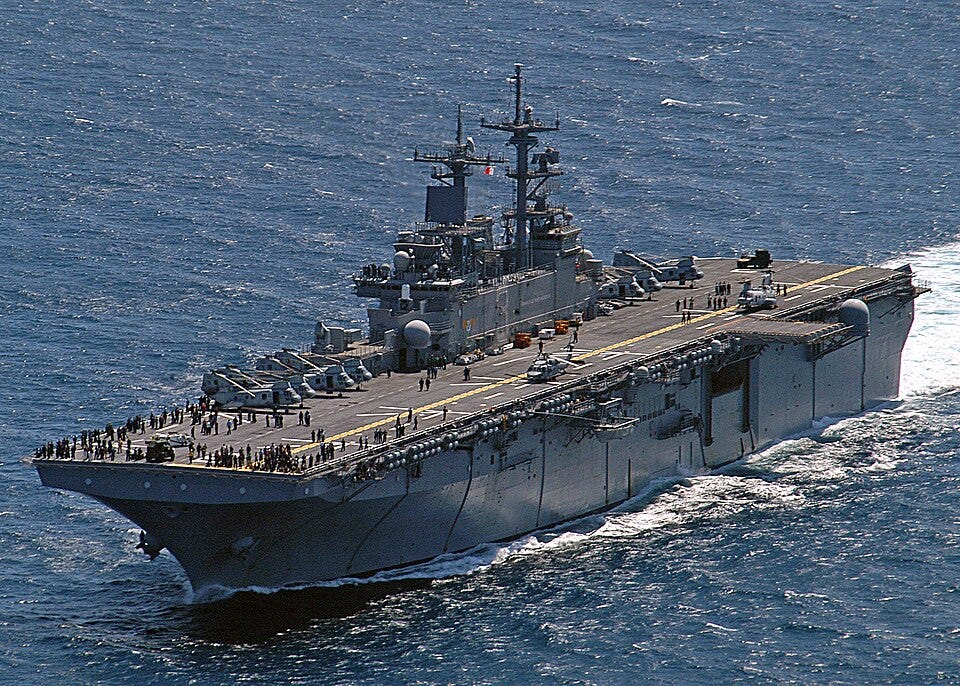
That’s 30 major amphibious ships, down one from the current 31-ship force. Unlike the current 31-ship model, this structure reflects a clear division of labor. The 24 ships assigned to the Expeditionary Warfare model exist for warfighting. The 6 patrol LPDs exist for persistent partner presence.
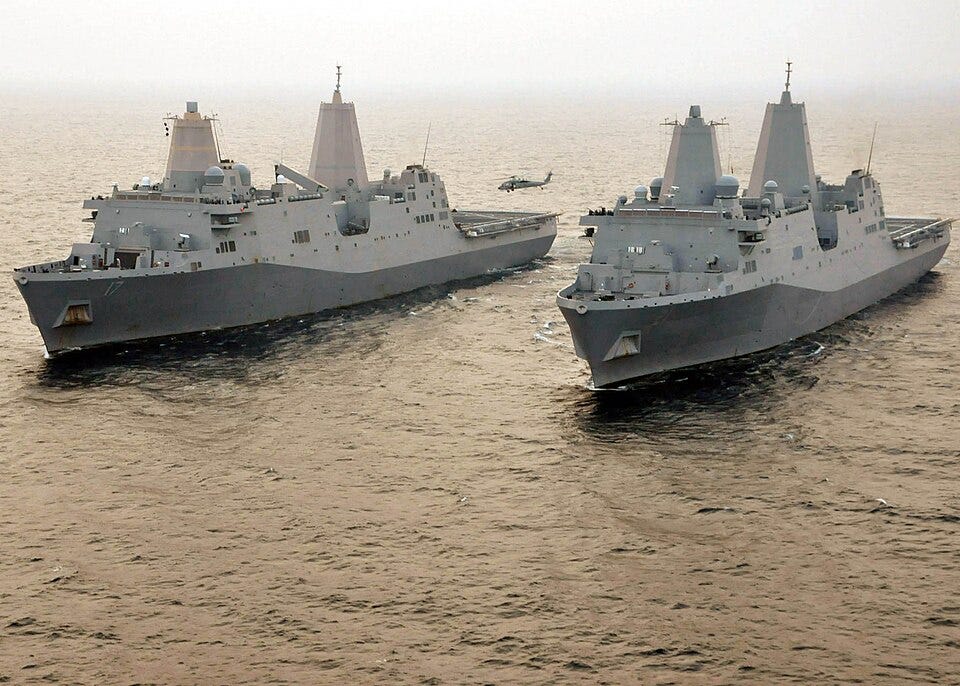
All too often, ARG/MEU teams get tied up on presence and partnership missions. These missions are valuable, but they wear down ships, personnel, and equipment that we need to keep in good order to respond to any crisis. By detailing a group of 6 LPDs for the partnership and presence role, we free up the rest of the force to stay constantly vigilant and prepared to fight wherever Marines might be needed.
One set is kept sharp, while the other maintains visibility.
The rest of this week’s article will focus on the 8 big decks and the first 16 LPDs. We’ll talk about that second set of LPDs next week, but for those who are curious I outlined much of the role in an earlier article.
Introducing the Fleet Marine Expeditionary Forces
Instead of the current ARG/MEU construct, I propose organizing the heavy amphibious force into two standing forces, one for the Atlantic, and one for the Pacific, similar to the structure I proposed for the CVN force. This structure enables something the Navy and Marine Corps have never had in peacetime: standing, named amphibious formations with predictable rotations.
Each coast will host a Fleet Marine Expeditionary Force—Atlantic and Pacific. Each FMEF includes four big decks and eight paired LPDs. These twelve ships form the equivalent of two operational Amphibious Ready Groups at a time, each with a full chain of command afloat.
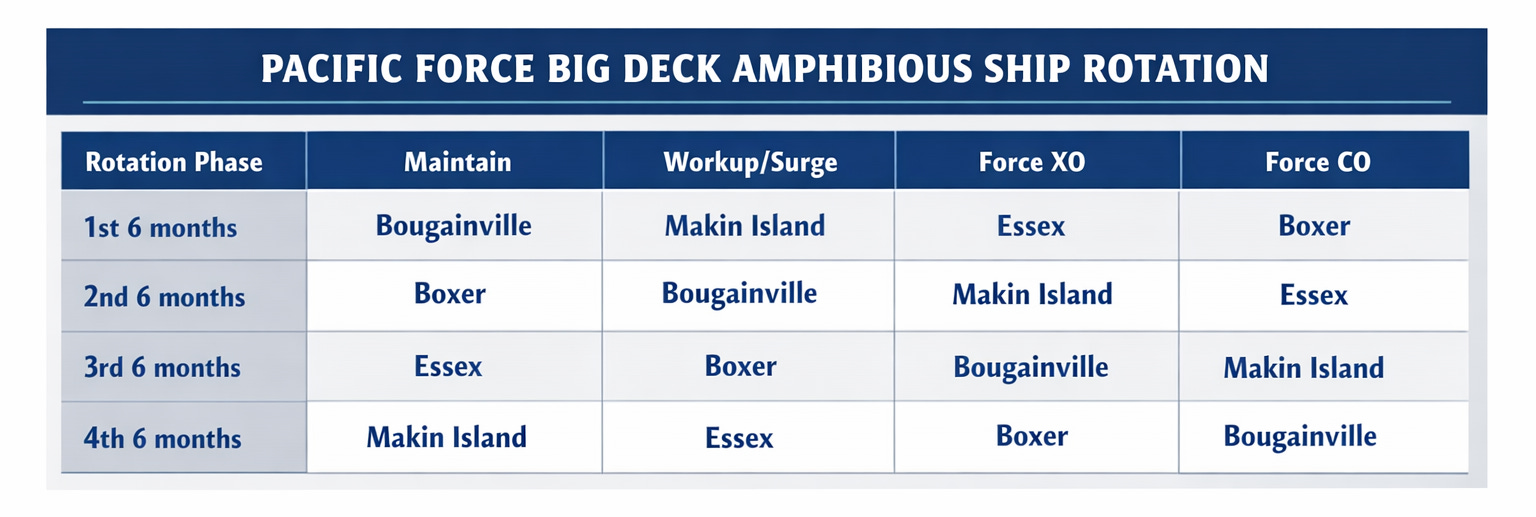
Each FMEF operates under a fixed cycle. Ships rotate through four six-month phases: maintenance, workup/surge, FMEF XO, and FMEF CO. During the XO and CO phases, the big deck ships are assigned to operational leadership roles under a rear admiral and a vice admiral, respectively. Each trio—one big deck and two LPDs—cycles through together. The result is a structure with rhythm, continuity, and discipline.
Here’s what that rotation looks like:
The Tasking Cycle: Peaks and Valleys On Purpose
This isn’t simply a deployment model, it’s a readiness model. Ships aren’t deployed for six months or forward-staged for a year. They cycle regularly through homeport—training at sea, resting at home, and maintaining their ability to fight. The key is the rhythm: six months in dock, six months sharpening, six months executing under the deputy commander, and six months under the commander.
Ships don’t stay out the whole time during their availability phases. They go out, train, and then come back to do light maintenance. This keeps small problems from becoming big issues, and allows for improved preventative maintenance. This keeps the ships and equipment in fighting shape.
That pattern isn’t just good for readiness. It’s good for morale. Crews know what’s coming. Families stay connected. Maintenance doesn’t pile up until it becomes a crisis. Repairs are done early. Damage control teams stay sharp. And when it’s time to surge, the ships surge ready—not rusted. These are not billboard ships. They are warfighting assets—rotated, rested, and prepared for the next fight.
Escorting Forces, Built-In
Each FMEF comes with escorting warships as a part of the package.
Each big deck is paired with a DDG-51 Flight III destroyer. This destroyer acts as its primary air defense ship, providing the sensor reach and fire control necessary to protect the formation and enable operations inside contested airspace. This destroyer rotates through the pattern with the big deck and its supporting LPDs. This means it goes through maintenance, workups, and time in the active force right alongside its assigned big deck.
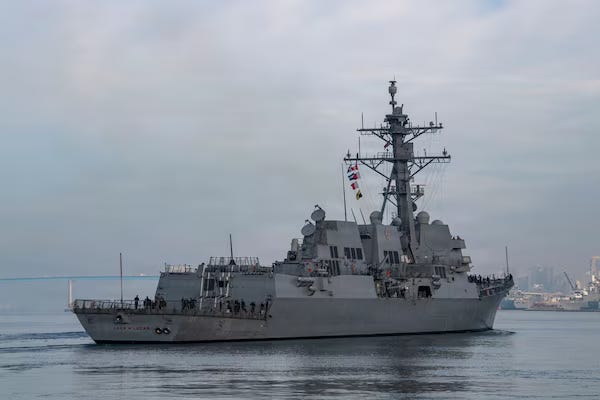
In addition, each FMEF is assigned two destroyer squadrons of six ships each, for a total of twelve destroyers, with a goal of having eight of the twelve available to deploy with the force at a time. These ships are a permanent part of the formation and the squadrons are subcommands of the FMEF.
Each FMEF is also assigned 32 unmanned surface vessels, with a goal of maintaining 24 available for deployment. These systems provide distributed fires and additional magazine depth, extending the reach and endurance of the formation without increasing the number of crewed ships.
The combined FMEF has the ability to function as one overwhelming force when required, or to separate into smaller units tailored to individual combatant command requests as needed. With the escorts and command structures built in, the overall force is by nature flexible to almost any situation, from forced entry to maritime interdiction.
This force structure isn’t about legacy. It’s about function. We don’t need to rebuild what we had. We need to build what actually works in the world we actually live in.
The Marines aren’t here to sustain army-style land campaigns. They’re here to punch forward, hold the edge, and make first contact count. That’s what this force enables. That’s what this model supports.
Next Friday, we’ll take a look at the light amphibious ships needed to support the EABO concept as well as the LPDs assigned to cover the partnership role.
-Alan Ramsey
Fleet Logic is an independent publication offering commentary, opinion, and analysis on naval strategy, defense acquisition, and related topics. While we strive for accuracy and thoroughness, the views expressed are those of the author and do not represent official positions of the U.S. Navy, Department of Defense, or any affiliated organization. This newsletter is for informational purposes only and should not be construed as professional, military, or legal advice.
Fleet Logic is written from an independent civilian perspective and is not affiliated with any official military command, veterans’ organization, or defense contractor.
All analysis is based on open-source materials and publicly available data; no classified or privileged information is used.
References to U.S. military programs are intended for broad educational and analytical purposes only and are based entirely on publicly accessible information.
I think what I like most about your vision is the consistent cycling and partnership of vessels. The predictability around availability and clear asset grouping actually provide a greater overall flexibility while maximizing the value of training. You'll almost always need these groups of capabilities, so it makes a lot of sense to package them upfront.
Like too many ideas listed by Commander Salamander, this suffers from too much sense to get done.