
Restructuring the Amphibious Force for a Multifaceted World Part II
Fleet Logic Issue 37 - April 17, 2026

“We fight our country’s battles, In the air, on land, and sea;” - Marines’ Hymn
Last Friday, I began to discuss the amphibious fleet. I am of the mind that both missions - the traditional mission of global expeditionary operations as well as the new mission of Expeditionary Advanced Base Operations (EABO) set out in the Force Structure plan have real value, and the amphibious fleet must be designed to support both operations.
The bulk of last week’s issue was about the traditional mission. This week, I’d like to talk about the other mission, and how the fleet can support EABO.
Landing Ship Medium
There is a strong instinct in the Navy to demand the “perfect” ship. Fast. Heavily armed. Survivable on its own. Capable of everything. That instinct has produced a long trail of programs that became expensive, slow, and—too often—late.
The Landing Ship Medium (LSM) is one of the rare cases where the Navy appears to be resisting that instinct.
A big part of the LSM’s job is to move people and equipment between islands so the force can get positioned along friendly island chains and weaponize that geography. To do that job, “simple, real, and buildable” is not a bug, it’s a feature, and so far it looks like they are sticking to that.
In December 2025, USNI reported that the Navy paid Damen $3.3 million for the technical data package for the Landing Ship Transport 100 (LST 100), and that the LST 100 would serve as the baseline for the McClung-class Landing Ship Medium program. That same report described the Navy’s intent as staying very close to the baseline, with Secretary of the Navy John Phelan emphasizing that the design should require “not many, if any, design changes,” and that requirements need to be locked before construction with change orders tightly controlled. (See USNI News: Navy Retools Landing Ship Medium Program Around Dutch LST-100, Vessel Construction Manager to Lead Design Process) USNI
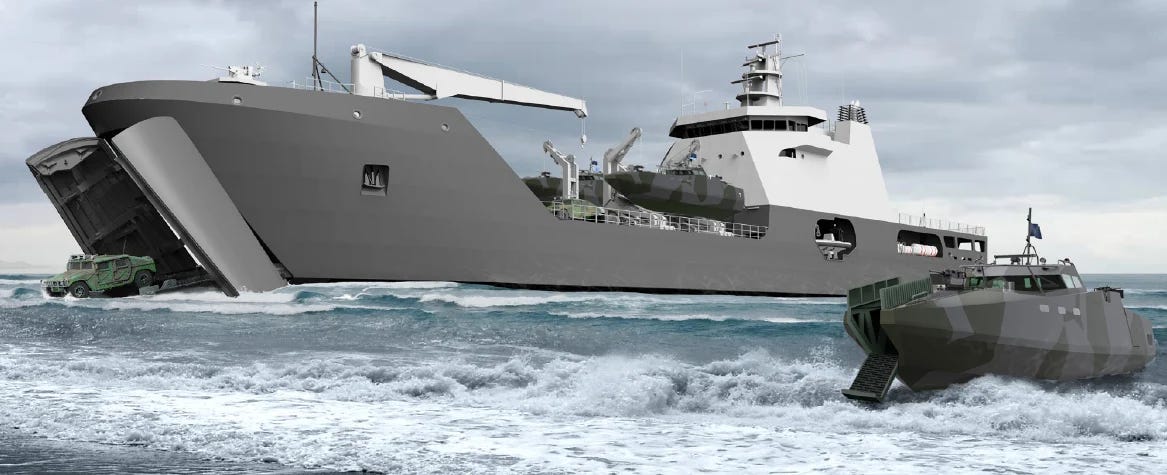
If that is the approach, and the Navy is explicitly saying it is, then expectations for size and basic performance should be anchored to the LST 100 itself. The Damen product sheet describes a ship at 100 meters (328 feet), 16 meters beam, 3.50–3.85 meters draft aft, 15 knots speed, greater than 4,000 nautical miles of range at 13 knots, 15 days endurance, and a flight deck for one medium helicopter, along with roll-on/roll-off and cargo deck capacity. (See Damen: Landing Ship Transport 100) Damen
On February 18, 2026, NAVSEA announced it issued a Request for Proposal for a Vessel Construction Manager (VCM) to oversee Landing Ship Medium acquisition, with contract award anticipated mid-2026. NAVSEA also stated that, for initial production, the Navy would direct the Vessel Construction Manager to manage Landing Ship Medium construction at Bollinger Shipyards and Fincantieri Marinette Marine. (See NAVSEA: U.S. Navy Issues Request for Proposal for Vessel Construction Manager to Accelerate Medium Landing Ship Acquisition) NAVSEA
That acquisition structure is not window dressing. It is an attempt to enforce discipline, and discipline is something that is needed. Honestly, it is needed at all levels, from the congressional level on down, but it is good to see the fleet making a conscious move in that direction. This method should keep the design stable and prevent the usual pattern where the ship gets redesigned while it is being built.
And, perhaps the best part, they are in process. On April 15, 2026, Fincantieri announced a $30 million award for long-lead materials plus engineering and production-readiness activities tied to the first four ships, and stated that this work supports a construction start as early as the fourth quarter of 2026. (See Business Wire: Fincantieri Secures First U.S. Navy Contract for LSM Program) Business Wire
This is why the Navy’s direction is the right move. It is accepting that the connector does not need to be exquisite to be decisive. The connector needs to be real, and it needs to be fielded in numbers. The Navy currently projects a need for 18 to 35. I propose that 35 should be the number, minimum. This high of a number covers attrition and maintenance, while ensuring that a sufficient number of ships are available at all times. The Landing Ship Medium is what makes EABO practical… without it, the system does not work.
The Patrol LPD Multi-Tool Ship
Another topic that needs to be addressed from last week is the other 6 LPDs, those that I stated were for use on presence and partnership missions. The reason for these ships is to free up the primary heavy amphibious force to focus on high end warfighting. Their focus should be on keeping their equipment and personnel trained and in a high state of readiness for that mission.
Those six Patrol LPD ships are the same ships and the same concept described in “The Navy Owns a Multi-Tool Ship.” The point is straightforward. The Navy is already building San Antonio-class Amphibious Transport Dock ships, and they are uniquely suited to become forward-deployed utility ships. They can function as multi-mission platforms that can do useful work on their own with limited support from the other ships.
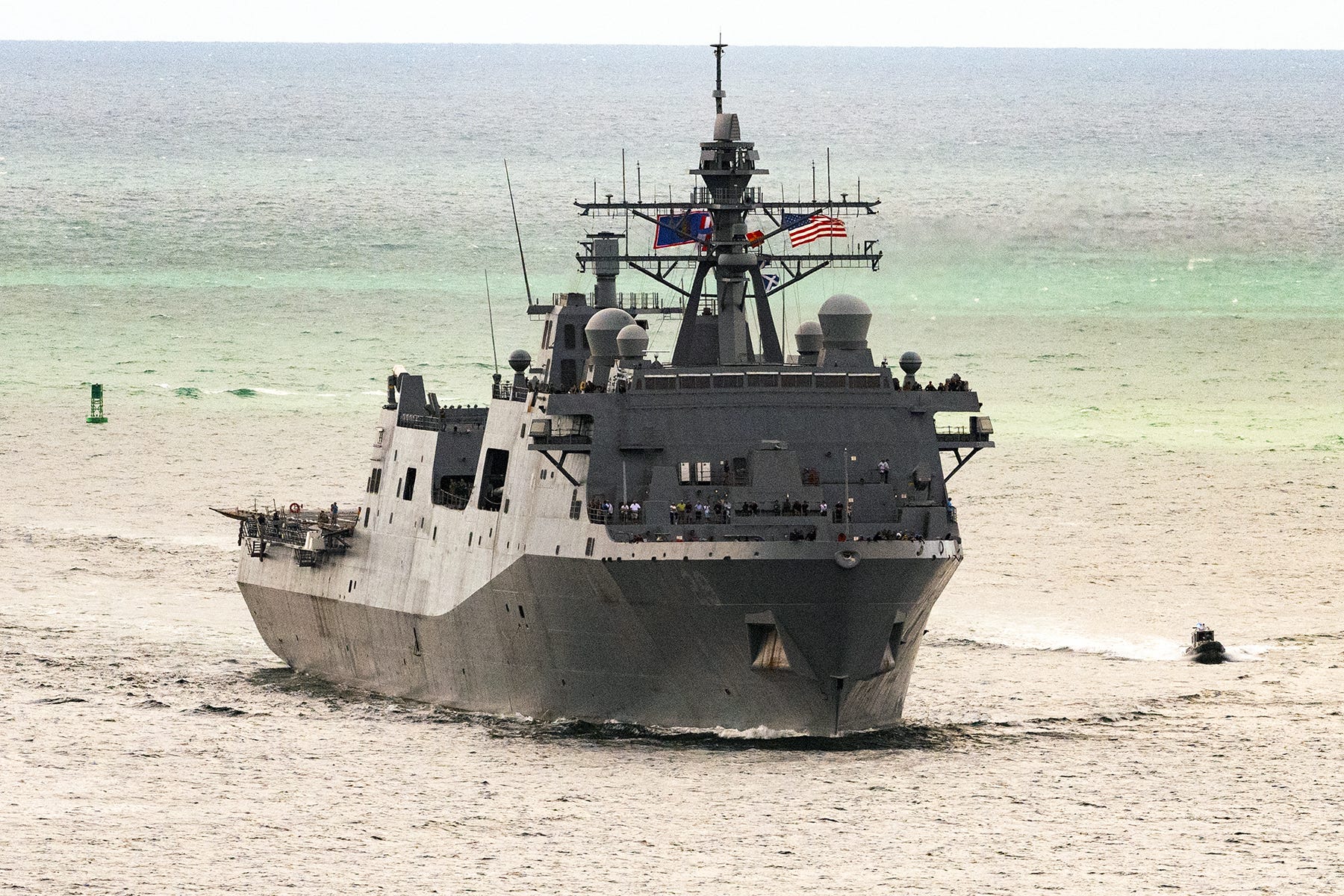
In peacetime, these ships cover the missions that chew up readiness. They can handle presence patrols and partnership work with allies and partners. Their large carry capability allows them to be equipped to assist with security cooperation, medical response, and Humanitarian Assistance and Disaster Relief. Having them each carry a force of Seabees allows them to assist with all manner of construction projects. There is solid value in this work, building up relationships and partnerships with local governments, relationships that can prove valuable in times of conflict.
This role should not be considered soft or needless. But it is also a demand that currently consumes resources from the fleet and can in large part determine whether there is margin or not. This work under present conditions quietly turns into deferred maintenance, shortened training, and a force that is always busy but never fully ready.
By having ships dedicated to this work in peacetime, we can create that margin in the main amphibious force.
At the same time, a ship as large as an LPD must have value in wartime as well. As proposed, these LPDs will carry an offensive and defensive fit that not only allows them to look out for themselves in peacetime, but also contribute meaningfully in conflict.
The proposal gives these ships a defensive fit built around a Vertical Launch System (VLS) firing Evolved Sea Sparrow Missiles (ESSMs), backed by two Rolling Airframe Missile (RAM) launchers, and a pair of 30mm guns. The proposal also calls for a loadout of 8 Naval Strike Missile (NSM) for credible offensive reach. It is intended to embark a Marine element and a High Mobility Artillery Rocket System (HIMARS) battery, and its aviation capability can include antisubmarine warfare helicopters.
Two grounding points matter here.
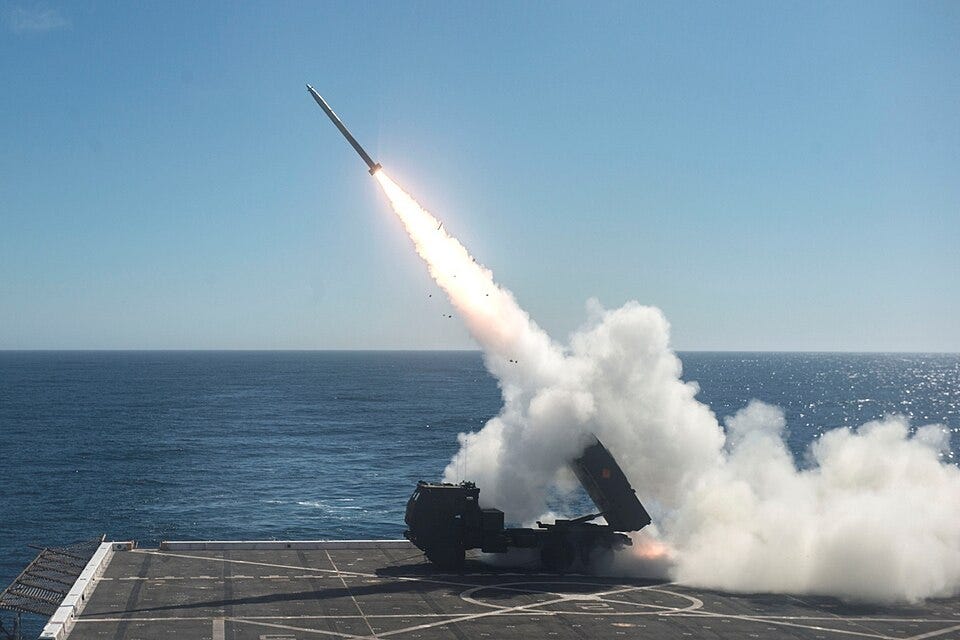
First, the Navy has publicly documented a High Mobility Artillery Rocket System fired from the flight deck of USS Anchorage (LPD 23) during Dawn Blitz 2017. That is real-world proof that the “LPD as fires enabler” concept is executable. (See U.S. Navy: Anchorage Conducts HIMARS Shoot During Dawn Blitz 2017) Navy
Second, the Vertical Launch System conversation is also quite feasible. USNI reported in 2016 that the original San Antonio-class concept included two 8-cell Mk 41 Vertical Launch System installations, that the capability was cut during development, and that there was renewed interest in bringing it back. (See USNI News: Navy, Marine Corps Considering Adding Vertical Launch System to San Antonio Amphibs) USNI
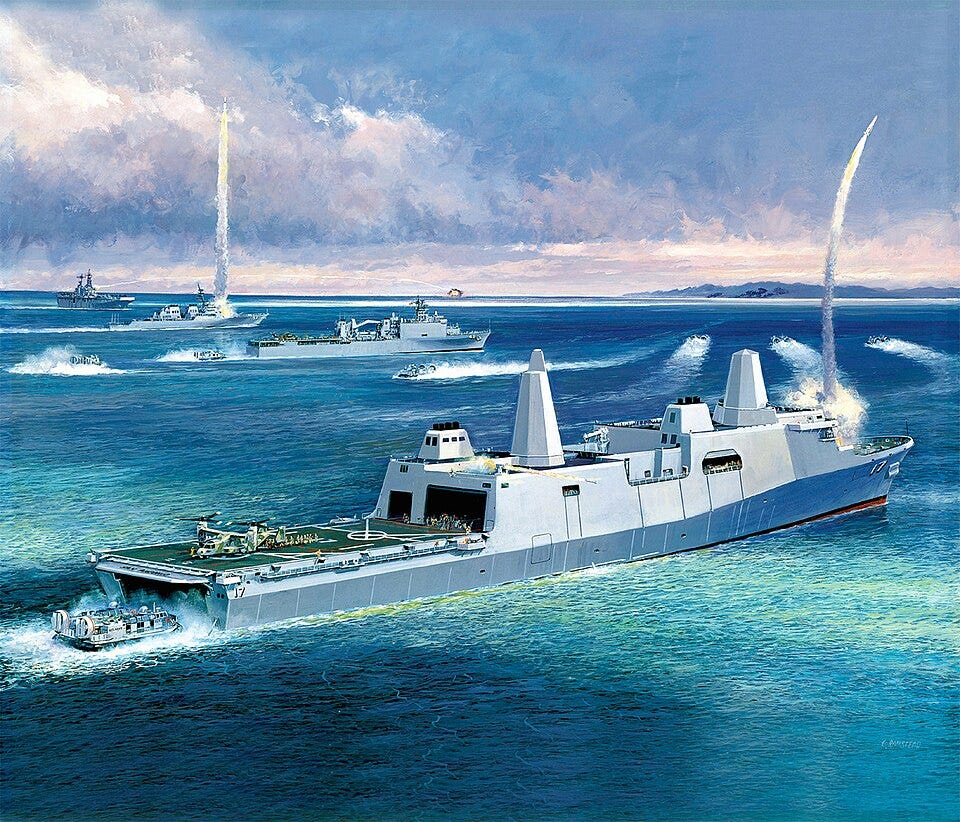
In wartime and crisis, these ships are not locked into a single doctrinal lane. They can support Expeditionary Advanced Base Operations when that is the requirement. They can also do something just as important: handle lower-priority regions outside the primary conflict zone, carrying the “everything else” load—presence, partner support, deterrence, practical response—so additional high-end resources can be sent to the main fight.
That is not a minor benefit. In a major fight, the map does not go away, and secondary regions can still generate crises, and partners outside the war zone still demand attention. Deterrence in secondary areas still requires visible capability. A fleet that cannot cover that reality without pulling forces out of the main effort will dilute itself at the worst possible time.
This is why these ships are strategically valuable. They are a Multi-Tool ship in the most literal sense, one hull that can cover multiple real missions, forward, with known capabilities that we already know how to build and that are currently being built. The “new” part is not the ship. The “new” part is deciding to treat six of them as a deliberately configured utility element with a clear job—to protect readiness by absorbing demand.
The Expeditionary Sea Base
There is one last class of amphibious warship I’d like to discuss today. That class is the often redesignated Expeditionary Sea Base, or ESB, formerly known as the T-MLP (Mobile Landing Platform) or the AFSB (Afloat Forward Staging Base). These are large ships based off the Alaska-class civilian oil tanker.
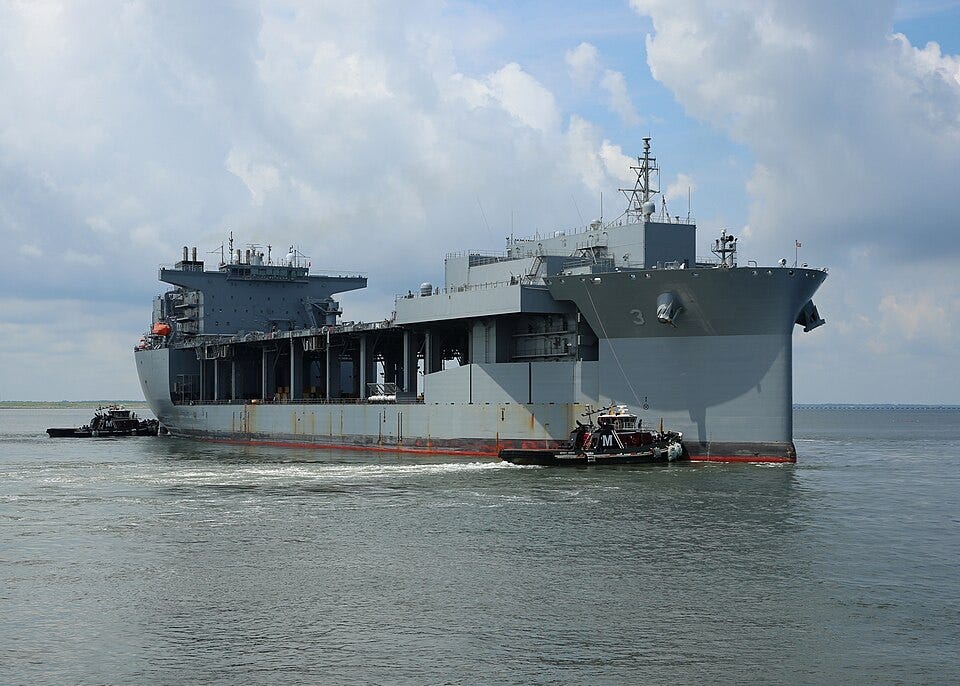
The Navy’s own description of these vessels is telling. ESBs are designed around four core capabilities: aviation facilities, berthing, equipment staging support, and command and control assets. Plainly spoken, they have flight deck space, people space, gear space, and staff space. That is a useful set of capabilities to have as part of a fleet that is trying to operate dispersed around the globe. (See Navy.mil: Fact Files Expeditionary Sea Base) Navy
The ESB is described as an afloat forward staging base variant designed to provide dedicated support for Air Mine Countermeasures (AMCM) and special warfare missions, with additional missions including counter-piracy, maritime security, and disaster relief. Given their versatility, I propose that each numbered oceangoing fleet should be equipped with one of these fine ships. As the Navy currently intends to have a total of six of them, there will already be enough to go around.
One per fleet allows each fleet to take advantage of the command and control assets of the class and use them as a command ship, assigning them to the roles currently played by USS Blue Ridge (LCC 19) and USS Mount Whitney (LCC 20). I am not saying that an ESB is a one-for-one clone of a purpose-built command ship. What I am saying is that these ships can provide something the fleet needs in practice: room for staff forward, a persistent afloat node, and the ability to shape that node to the mission set of the moment.
Landing Ship Medium is the Navy choosing discipline. It’s a real baseline design, a plan to control changes, and a ship that fits the mission in one package.
The Patrol / Multi-Tool LPD concept is the same discipline applied to something already owned: stop dragging the entire amphibious force into every problem, and instead dedicate a small set of ships to absorb constant global demand. This allows the high-end force to stay ready to fight.
The Expeditionary Sea Base is that same discipline applied to the staff and staging problem. It is built for space: aviation, berthing, equipment, and command. If the Navy is already planning to have six, then the fleet should use them deliberately. One per numbered fleet, as a forward node that can host staff, stage capability, and absorb the messy real-world missions that do not justify sending the formation.
Next week, we’ll take a look at the organization of the surface fleet.
As always, thanks for reading.
-Alan Ramsey
Fleet Logic is an independent publication offering commentary, opinion, and analysis on naval strategy, defense acquisition, and related topics. While we strive for accuracy and thoroughness, the views expressed are those of the author and do not represent official positions of the U.S. Navy, Department of Defense, or any affiliated organization. This newsletter is for informational purposes only and should not be construed as professional, military, or legal advice.
Fleet Logic is written from an independent civilian perspective and is not affiliated with any official military command, veterans’ organization, or defense contractor.
All analysis is based on open-source materials and publicly available data; no classified or privileged information is used.
References to U.S. military programs are intended for broad educational and analytical purposes only and are based entirely on publicly accessible information.
With due respect to earlier writers and similar thoughts, I have a distinct memory of Soviet Admiral Sergei Gorshkov saying “Better is the enemy of good enough.” We tend to try to design diamonds, but as a retired naval architect with a lot of experience in USN ships, I’ll tell you that at some point you need to shoot all of the requirements bubbas and engineers, and get on with cutting steel. Diamond designs are often based on a specific set of threat requirements that have a fleeting duration - what I term a fragile design rather than a robust, rigorous design - like trying to dance on a pin point where any small change in the forcing function renders it a waste of time and national treasure.
I think a primary design characteristic of all future ships should be modularity. Weapons positions should be supplied with an over abundance of power, cooling, and data connectivity and the surrounding structure designed to accommodate the highest potential load. Compatibility requirements should be pushed to the weapon system modules. Modularity could even be extended to crew compartments, under the assumption that crew size is mission dependent, and unneeded crew space could be used for other purposes.